
Back to Blog
Qatar's mobile networks were rebuilt from the ground up for the 2022 World Cup, and that investment still shows: dense 5G now covers Doha's entire tourist core, from the Corniche and Souq Waqif to West Bay, the Pearl, and the driverless metro connecting them. A data-only eSIM like co:sim's Qatar plan gets you online the moment you land, no airport SIM counter required. Two things are worth knowing before you go: desert safari routes past Sealine thin out predictably once you're deep in the dunes, and Qatar blocks the live call button inside WhatsApp and FaceTime at the network level, the same restriction several of its Gulf neighbors enforce. Text messages and photos work normally either way.
Qatar's telecom buildout for the FIFA World Cup 2022 was genuinely massive. Ooredoo's own after-action report counts 8,466 antennas placed across the eight tournament stadiums, more than 5,000 cells, and a network built to serve the crowds that came with it: Qatar hosted more than 1.4 million international visitors over the month-long tournament. The network held up — 801TB of data moved across the country and 11.4 million voice calls connected at a 99.95% success rate, per Ooredoo's own tournament figures.
That infrastructure didn't get dismantled after the final whistle. Four years on, it's the backbone of everyday coverage across the places a tourist actually spends time: the Corniche waterfront promenade, Souq Waqif's covered lanes, the West Bay skyline, the Pearl-Qatar's marina district, and the Doha Metro connecting all of them. If your Qatar trip stays inside that loop, a modern phone on a good network sees strong, consistent 5G the entire time.
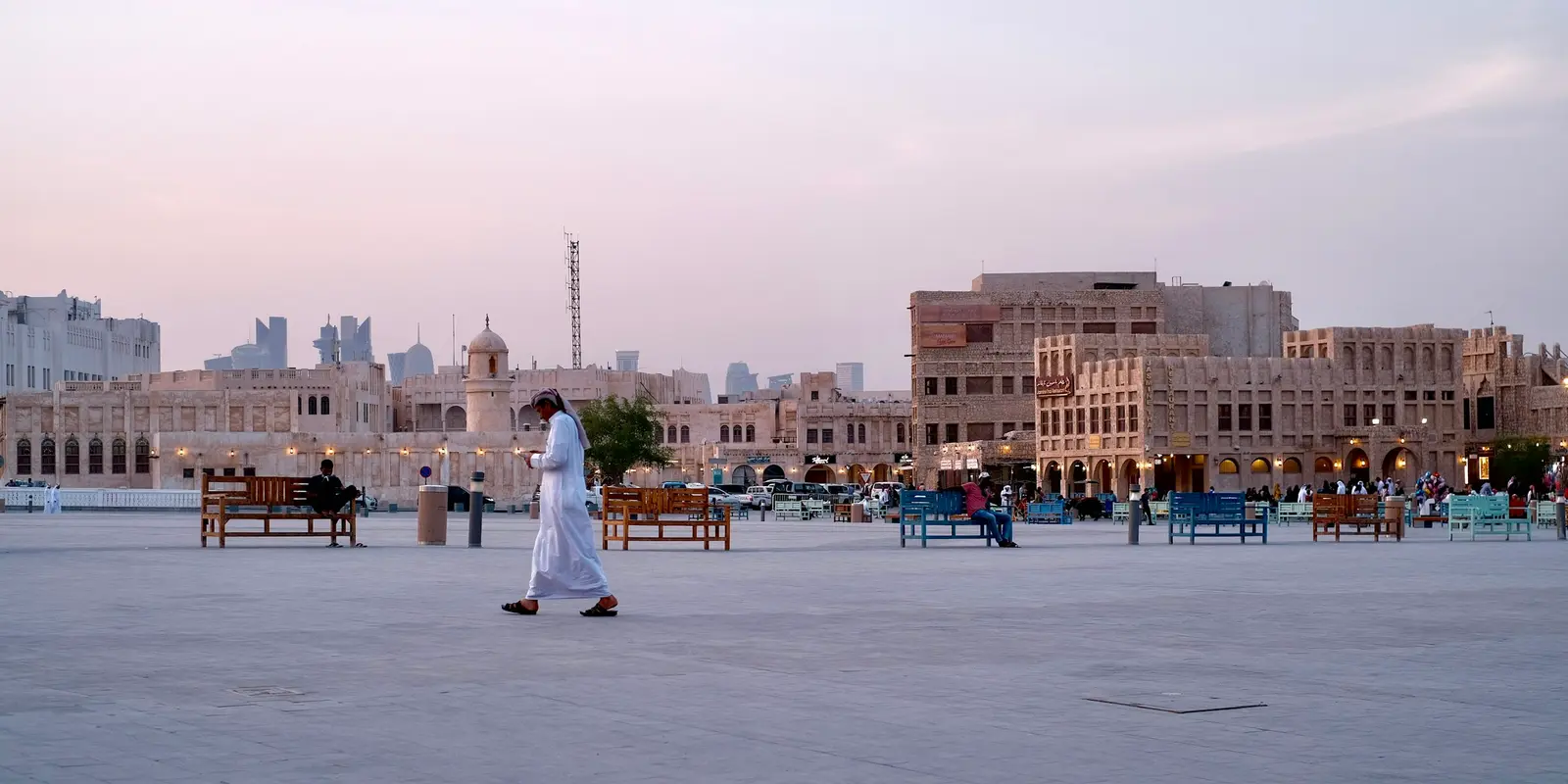

A half- or full-day desert safari (dune bashing, sandboarding, a night at a desert camp) is one of the most-booked tourist activities in Qatar, and most operators run routes toward Sealine Beach and the Inland Sea (Khor Al Adaid), roughly 80km south of Doha. Visit Qatar's own guide to the Inland Sea is blunt about the terrain: "there is no road that leads to it and a 4x4 vehicle is a must," with dunes reaching 40 metres and stretches of open sabkha flats between Mesaieed and the coastline.
That remoteness is exactly why coverage there behaves differently than it does in Doha. The same operators that built 5G across eight stadiums concentrate their towers where people actually live and work, which is Doha and the coastal municipalities — not the empty dune fields further south. Expect your connection to hold up fine on the paved stretch out of the city and to get noticeably weaker once your guide turns off-road into the Inland Sea itself. It's not a reason to skip the trip; it's a reason not to plan a video call around it, and to download offline maps or save your camp's coordinates before you leave cell range.
No, not the live call button specifically. This is the restriction that catches most tourists off guard: Qatar's telecom regulator, the Communications Regulatory Authority, classifies commercial voice-over-internet calling as a licensed telecommunications activity, and in practice that means Ooredoo and Vodafone Qatar block the real-time voice and video call feature inside WhatsApp, FaceTime, and Skype at the network level. This applies to any SIM or eSIM connecting through either carrier, including a data-only co:sim eSIM — installing one before you fly does not enable the call button, so don't plan on it for a video call home. Text messages, photos, and voice notes inside those same apps work exactly as normal.
The government-endorsed workaround is BOTIM, a licensed calling app that both sides of the call need installed. It works reliably, but only if the person you're calling has it too — worth sending a link before you land rather than discovering the gap from a Doha hotel room.
A short business trip or long weekend built around Doha (museums, the Corniche, Souq Waqif, a desert safari day) typically runs through 2-4GB with maps, messaging, and photo uploads running in the background. A longer stay, or one that leans on hotspot tethering or video streaming in the evenings, pushes that toward 8-15GB. Match the plan's validity window to your actual trip length rather than buying more days than you'll use, and check whether the plan is reloadable in case a connecting flight or a business meeting runs your visit longer than planned.
co:sim's Qatar eSIMEvery plan page lists which network the profile connects to, along with the install deadline and billing-start rule, so you can check the details before you buy rather than after you land.
Install it while you still have a dependable Wi-Fi connection, ideally a day or two before departure. co:sim emails the QR code within seconds of checkout, and adding the profile doesn't start most plans' validity clock — you can install at home and simply switch to it as your primary data line after landing. Keep your regular SIM active for calls and texts if you need to stay reachable on your home number; the eSIM only needs to be the one handling data.
If your itinerary also covers other Gulf countries, co:sim's regional Gulf plan covers Qatar alongside several neighboring destinations on one profile, which is worth checking if Doha is one stop on a longer trip rather than the whole thing.
No. Qatar's Communications Regulatory Authority restricts commercial VoIP calling to licensed providers, and Ooredoo and Vodafone Qatar enforce that by blocking the live call feature inside WhatsApp, FaceTime, Skype, and similar apps at the network level. This applies to every SIM and eSIM connecting through either carrier, including a co:sim data-only eSIM — there's no workaround available through the connection itself. Text messages, photos, and voice notes in the same apps are unaffected and work normally. If you need real-time voice or video calling while you're in Qatar, BOTIM is the government-endorsed alternative; both people on the call need the app installed, so it's worth sending the download link to whoever you'll be calling before you travel, rather than finding out the restriction exists from a hotel room in Doha.
It depends on how far off-road you go. The paved route out of Doha toward Mesaieed and Sealine Beach sits inside solid coverage, but Qatar's mobile towers are concentrated where people live, not in the open dune fields around the Inland Sea (Khor Al Adaid). Visit Qatar's own guide to the area describes it as reachable only by 4x4, with no paved road in. Expect your signal to weaken predictably as your guide turns off-road, and don't count on a live video call or real-time navigation once you're deep in the dunes. It's a normal part of the experience rather than a network fault — download offline maps and share your camp or meeting point with someone before you lose signal, the same precaution any remote desert trip calls for regardless of provider.
Qatar has exactly two mobile operators, Ooredoo and Vodafone Qatar, and both run dense 5G across Doha and the coastal municipalities following the infrastructure built for the 2022 World Cup. Each co:sim Qatar plan page states which of the two networks the profile connects to, along with the install deadline and billing-start rule, so you can check the specifics before you buy rather than assume. In practice, either network delivers strong coverage across the places tourists spend time (the Corniche, Souq Waqif, West Bay, the Pearl, and the Doha Metro), with the only meaningful gap being genuinely remote desert terrain well outside the city, not a difference in quality between the two carriers. Neither operator publishes a tourist-facing coverage map, so the plan page's network listing is the most reliable way to know in advance which one your eSIM will use.
A three- to four-day trip covering the city's main sights, a souq visit, and a half-day desert safari typically uses 2-4GB, assuming normal maps, messaging, and social media use with photos uploading in the background. That figure climbs toward 8-15GB if you're streaming video, using your phone as a hotspot for a laptop, or staying closer to a week. Match your plan's validity window to your actual trip length, since buying extra days you won't use doesn't add value, and check whether the plan supports a top-up in case your visit runs longer than expected — useful if a connecting flight or an extended business trip changes your schedule after you've already landed. A reloadable plan also means you don't need to hunt down a second eSIM mid-trip if your original estimate turns out to be short.
A Qatar eSIM installed before departure gets you connected from the moment you land, without an airport SIM counter or a language barrier at a local carrier store standing between you and a working connection.
Instant delivery by email · Install before you fly
 Travel Tips
A practical guide to internet in Saudi Arabia for Hajj and Umrah pilgrims: how the Nusuk app works, where networks get congested during the pilgrimage, honest notes on WhatsApp calling, and why installing an eSIM before you fly skips the biometric SIM counter.
 Travel Tips
A practical guide to internet in Israel for tourists: free city Wi-Fi, SIM and eSIM options, desert coverage gaps, and why Shabbat closures (including the airport SIM counter) make installing an eSIM before you fly worth it.
 Travel Tips
Staying connected in Czechia depends on where your phone plan is from. Here's what actually works in Prague, including the metro, and how to set it up before you land.
 co:sim Team