Back to Blog
Egypt has strong mobile coverage in its cities and along the Nile Valley, patchy signal in the desert and Sinai's interior, and onboard ship WiFi that ranges from genuinely useful to barely functional depending on which vessel you're sailing. If you've already compared eSIM data plans for Egypt, this guide is different: it's a planning overview of what connectivity actually looks like on the ground, in Cairo, on a Nile cruise, and at the Red Sea resorts, rather than another plan comparison. The short version: install a data-only eSIM like co:sim's Egypt plan before you fly, expect the strongest signal in Luxor and Aswan and weaker signal on the river between them, and treat onboard ship WiFi as a backup rather than your main connection.
Most visitors choose between four options, often mixing two of them.
Hotel and cafe WiFi is common in Cairo, Alexandria, Luxor, Aswan and the Red Sea resort towns, but quality varies hotel to hotel and is close to useless the moment you step outside. Airport SIM counters at Cairo International sell physical SIMs from Vodafone, Orange and Etisalat (branded e&), but you'll queue after a long flight, need your passport for registration, and be stuck with whichever carrier has stock that day. Pocket WiFi rental covers a group sharing one device, at the cost of carrying and charging extra hardware for the whole trip. A data-only eSIM installs before you leave home, activates on arrival, and avoids the airport queue entirely — co:sim's Egypt eSIM, for example, arrives by email within seconds of checkout, so it's ready before you've even packed.
Egypt's mobile market is regulated by the National Telecommunications Regulatory Authority (NTRA), which oversees four national operators: Vodafone, Orange, Etisalat (now e&) and WE (NTRA, 2026). Vodafone Egypt is the largest by subscriber share, with roughly 42% of the mobile market, followed by Orange at around 26% (Wikipedia: Vodafone Egypt, 2026). A destination eSIM built on this kind of local network gives you the same coverage map as a local subscriber, without a physical SIM swap.
Data needs in Egypt depend heavily on itinerary shape, not just trip length.
Cairo and Giza, 3-5 days: maps for navigating between the pyramids, the Egyptian Museum and Islamic Cairo, ride-hailing apps, and translation on the fly. A modest daily allowance covers this comfortably, since hotel WiFi picks up the slack for anything heavier in the evening.
A Nile cruise, 7-10 days: this is where planning actually matters, because you can't count on hotel WiFi to fill the gaps. Download offline maps, guidebook PDFs and any streaming content before you sail, and budget more data than a city trip since the ship's own WiFi (below) can't be relied on for the whole itinerary.
A Red Sea resort week (Hurghada, Sharm El Sheikh): resort WiFi is generally decent, so day-to-day data needs are lighter — messaging, photo uploads, and the occasional video call back home.
Expect the most consistent 4G/5G signal in Cairo, Giza, Alexandria and the Nile Valley cities of Luxor and Aswan, where both Vodafone and Orange maintain dense networks. Vodafone's coverage is generally described as strongest along the Nile corridor into Upper Egypt, which matters directly for cruise passengers (more on that below).
Coverage thins out fast once you leave populated areas. The Western Desert, the Sinai interior away from the coastal resort strip, and long stretches of open road between cities can drop to no signal at all. None of this is co:sim-specific — it reflects the physical reach of Egypt's own cell towers, and any SIM or eSIM on those networks will see the same gaps. Download what you need before you leave a connected area, and don't plan on a video call from the middle of the desert.
This is the part most general Egypt guides skip, and it's worth getting right before you sail.
Onboard ship WiFi is usually included, but it's not broadband. Most Nile cruise operators bundle WiFi into the fare rather than charging separately for it, and river cruise lines generally describe onboard WiFi as sufficient for email and messaging rather than a substitute for a hotel connection (Crui.se River Cruise WiFi Guide, 2026). Treat it as a backup for checking messages between excursions, not your primary connection for the week.
Ship generation matters more than most travelers expect. Newer, purpose-built vessels have noticeably better onboard coverage than older ones on the same route. Viking's newest Nile ships, Viking Osiris and Viking Aton, are built with wider, ship-wide WiFi coverage, while older vessels on the same itinerary — Viking Ra, for instance — have historically had weaker signal that's mostly limited to shared public areas rather than every cabin (Crui.se, 2026). Viking's own listing for Osiris confirms WiFi is included in the standard fare alongside meals and shore excursions (Viking River Cruises: Viking Osiris, 2026). If ship-wide connectivity matters to your trip, it's worth asking your cruise line which vessel class you're booked on, not just which company.
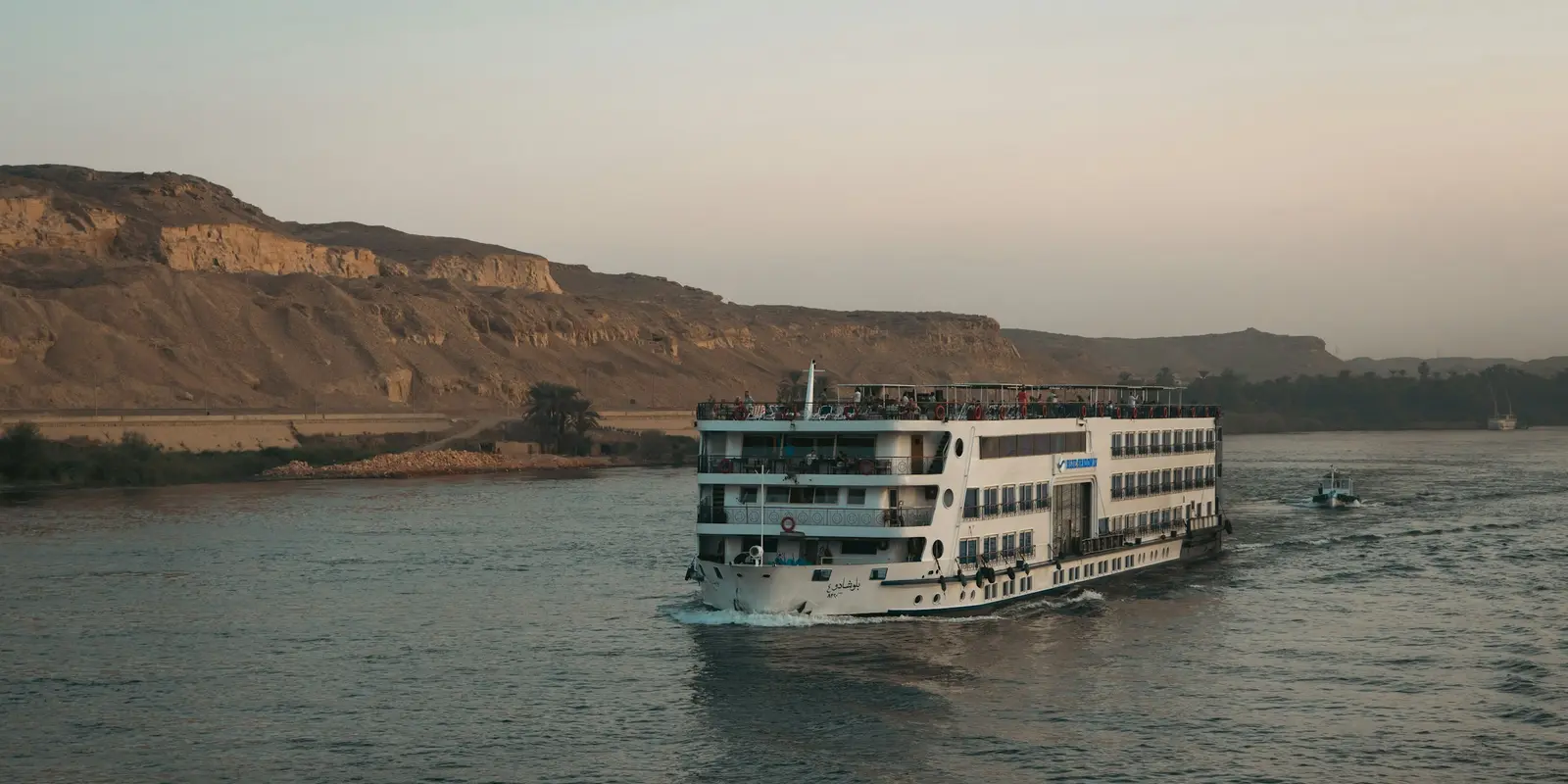
Cellular signal follows the river towns, not the river. Because a mobile eSIM connects to Egypt's regular cell towers rather than a ship-based satellite link, your signal strength tracks proximity to population centers along the bank. Expect a reliable connection while docked at Luxor, Aswan, Edfu and Kom Ombo, and expect it to fade during the quieter sailing stretches between them, where the riverbank is agricultural land rather than a town. This is exactly why a data-only eSIM like co:sim's, installed before departure, is more useful on a Nile cruise than most travelers assume: it picks up signal automatically the moment the ship approaches a town, with no local SIM swap needed mid-cruise, and co:sim's Egypt plan page shows the underlying network and install deadline upfront so there's no surprise about when the clock starts.
Browse co:sim's Egypt eSIM plansInstall your eSIM at home, over your own WiFi, a day or two before departure — most data-only eSIMs, co:sim's included, start their validity window on first connection to a network in Egypt rather than at install, so installing early costs you nothing. Keep your old SIM or a second eSIM active for calls and SMS if you need a phone number, since data-only plans don't include one. On the ship, connect to cellular data (not the ship's WiFi network) whenever you want a stronger connection while docked, and save the onboard WiFi for the quieter overnight sailing hours.
Yes. Your phone must be carrier-unlocked and eSIM-compatible — most iPhones from the XS/XR generation onward and recent flagship Android phones qualify, but it's worth checking your specific model before you book anything. If your phone is locked to a home carrier, contact that carrier to request an unlock before you travel; it typically takes a few business days to process, so don't leave it until the morning of your flight. Once unlocked, installing a data-only eSIM for Egypt takes only a few minutes: scan the QR code emailed to you right after checkout, and the profile installs alongside your existing SIM rather than replacing it, so you keep your home number for calls and texts while the new eSIM handles data. co:sim's Egypt eSIM is delivered this way, ready to install as soon as you've confirmed your phone is unlocked and compatible, well before you leave for the airport.
Yes, Cairo International Airport provides free WiFi in its terminals, and it's generally enough for checking messages, confirming a ride-share booking, or looking up your hotel's address while you wait at baggage claim. Like most busy international airports, though, the network can slow down noticeably during peak arrival waves, when hundreds of passengers connect at once. That's not a reason to skip arranging data before you land: you'll want a working, reliable connection the moment you step outside the terminal for a taxi or ride-hailing pickup, which is well before you'd reach a hotel's own WiFi. Installing a data-only eSIM before departure means your phone is online from the moment you land, without depending on how crowded the airport's shared network happens to be that day, or whether it's working at all.
A mobile eSIM connects through Egypt's ordinary cell towers on land, not through the ship itself, so it works wherever those towers reach — reliably while docked at river towns like Luxor, Aswan, Edfu and Kom Ombo, and less reliably during the quieter stretches of river sailing between them, where the banks are agricultural land rather than population centers. It complements, rather than replaces, whatever WiFi the cruise ship provides, and gives you a second, independent way to get online when the ship's own connection is slow or unavailable. co:sim's Egypt eSIM connects to the same local carrier networks you'd get from a regular Egyptian SIM card, so wherever a phone on that network has signal along the river, your eSIM has signal too — no separate ship WiFi password or paid onboard package required.
No. A single Egypt-wide eSIM plan, like co:sim's, covers Cairo, the Nile Valley and the Red Sea coast under one profile, because it connects to the same national carrier networks across the whole country rather than a region-specific one. That means there's no need to buy a second SIM or eSIM just because your itinerary adds a few resort days in Hurghada or Sharm El Sheikh onto a Nile cruise or a Cairo stay — the same eSIM you installed before departure keeps working as you move between cities, the river and the coast. It's one of the more overlooked conveniences of a data-only eSIM versus a local prepaid SIM tied to wherever you happened to buy it: coverage follows the network, not the point of sale.
A trip to Egypt is genuinely three different connectivity environments stitched together — dense city coverage, cruise-route coverage that follows the towns, and resort WiFi that fills in the rest. Installing a data-only eSIM for Egypt before you fly covers all three without a single airport queue or mid-trip SIM swap.
Instant delivery by email · Install before you fly
 Travel Tips
A practical guide to internet in Saudi Arabia for Hajj and Umrah pilgrims: how the Nusuk app works, where networks get congested during the pilgrimage, honest notes on WhatsApp calling, and why installing an eSIM before you fly skips the biometric SIM counter.
 Travel Tips
A practical guide to internet in Israel for tourists: free city Wi-Fi, SIM and eSIM options, desert coverage gaps, and why Shabbat closures (including the airport SIM counter) make installing an eSIM before you fly worth it.
 Travel Tips
Staying connected in Czechia depends on where your phone plan is from. Here's what actually works in Prague, including the metro, and how to set it up before you land.
 co:sim Team