
Back to Blog
For Vienna, Prague and Budapest by train, compare a regional eSIM covering Austria, Czechia and Hungary with three separate country plans before buying. A single co:sim Europe 33 plan can simplify the data line across this exact route if all three destinations appear in that plan's live coverage list; keep your tickets and station names offline because onboard Wi-Fi is a convenience, not a guaranteed connection.
The straightforward itinerary is Vienna, then Prague, then Budapest. ÖBB describes direct Railjet services from Vienna to Prague; its page says the direct service runs regularly, but you should select the departure that fits your actual travel date. For the second leg, MÁV's published Metropolitan corridor timetable maps Prague through Brno and Bratislava toward Budapest. Use a current booking engine or operator timetable for the specific train, stop pattern and arrival station.
This order avoids a return to Vienna between capitals. It also creates two cross-border travel days where a working map, station platform update and booking email matter more than heavy streaming. Ticket availability, engineering works and border schedules can change; a static article should be a route framework, not a substitute for the journey printed on your ticket.
Start with the live co:sim Europe 33 regional plan page. Open its destination list and verify Austria, Czechia and Hungary for the particular plan you intend to buy. A regional name is not a promise of identical coverage, speed or network on every stretch of railway. The benefit is operational simplicity: one installed data line can be used through the three-country itinerary, subject to the product's actual coverage and validity.
Separate plans can be sensible if one stop is much longer than the other two, you need a different data allowance in one city, or you already have an eligible home roaming allowance in part of the route. Inspect the Austria, Czechia and Hungary pages individually. Compare total allowance, duration, covered networks and the number of profile changes you are willing to manage, rather than assuming the cheapest-looking single-country headline will suit all three stops.
The EU's roaming guidance says eligible travelers with an EU home subscription can generally roam at domestic rates in other EU countries, subject to fair-use conditions. It does not automatically give a visitor from outside the EU a free data allowance. Check your carrier's terms before deciding whether a travel eSIM adds value.
For the first leg, compare departures on ÖBB's Vienna–Prague route page and read the station shown on your ticket. Photograph or download the ticket before you reach the platform. Do not treat a city name alone as a sufficient station address: a train may arrive at or depart from a station different from the one your hotel map first suggests.
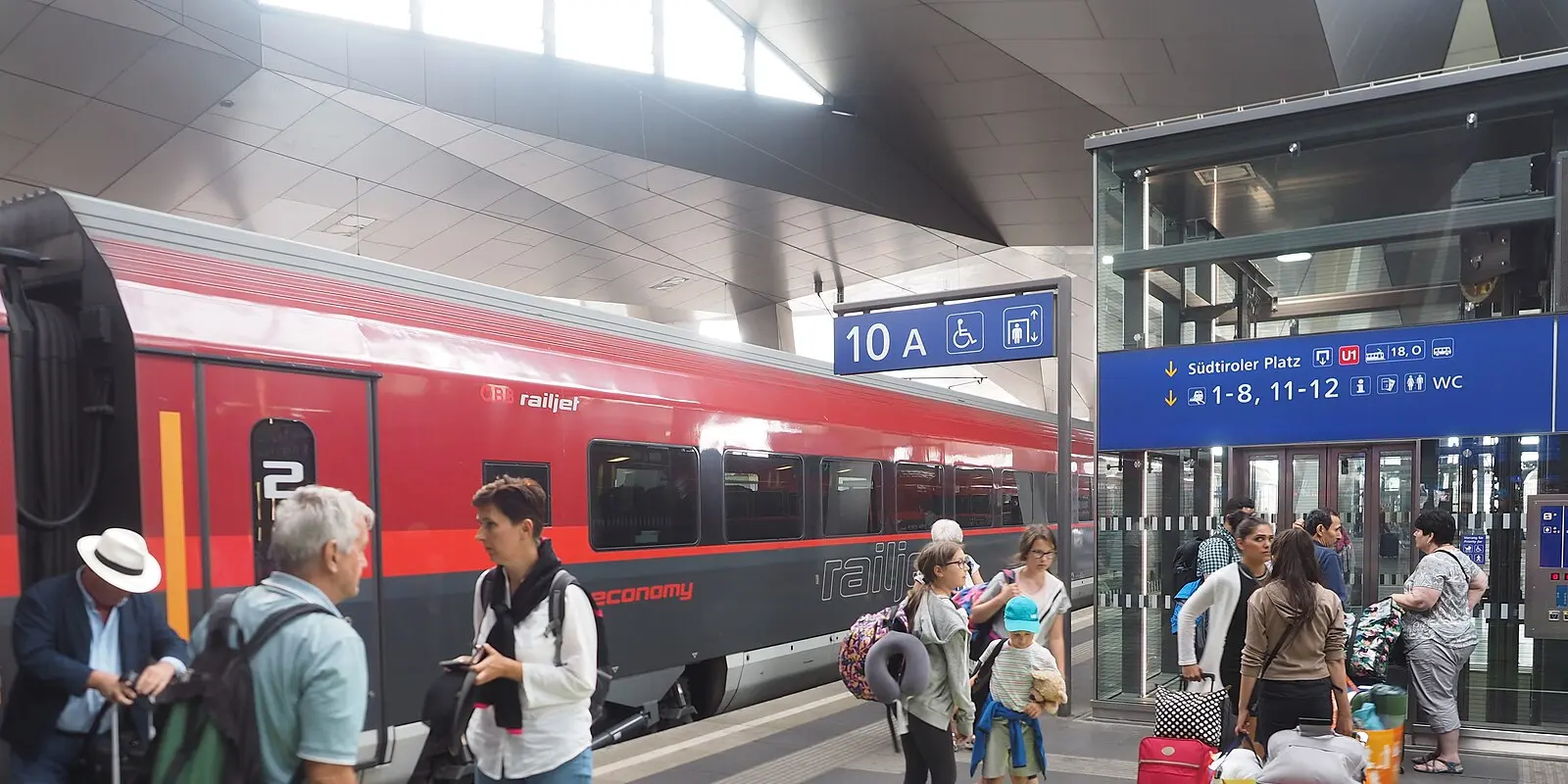
ÖBB lists WLAN and Railnet among the Railjet's onboard facilities. That is useful for a message or quick check, but it does not establish continuous usable internet on every cross-border segment. Download the Prague accommodation address and any important booking files ahead of boarding. If you need live platform information or to arrange a pickup, let cellular data be your primary connection where coverage exists.
The Prague stop is an opportunity to check how much data you have actually used. A maps-and-messaging itinerary may consume much less than a remote-work day or video calls. Your account dashboard shows the purchased plan; check the plan page for whether that specific product supports a top-up instead of assuming that every plan does.

The MÁV Metropolitan corridor timetable shows the Prague–Brno–Bratislava–Budapest axis. Choose your actual train by date and read its end station and any current disruption notice. The train's route through Slovakia is another reason to check the exact regional eSIM coverage list: a plan that includes your three overnight countries may or may not cover every transit country on the line. Avoid relying on a station's Wi-Fi for a border crossing.
Once you reach Budapest, BudapestGO is the BKK transit app for journey planning, traffic information and digital tickets. BKK notes that buying and using mobile tickets requires a phone with a connected mobile network. It also explains ticket validation rules on the same page; purchase alone is not always the final step before boarding. Set up the app before the travel day, then check the route from the actual arrival station to your accommodation.
Keep a second route to your lodging: a saved address, a screenshot of the transit journey, or the name of a licensed taxi pickup point. A battery that lasts to the hotel is more useful than a large data allowance on a powered-off phone. If your plan uses a data-only eSIM, a local phone call or conventional SMS still needs another voice service.
Confirm that the handset is unlocked and supports eSIM. Buy the plan only after reading the live list of covered destinations and the plan-specific activation and billing-start details. The QR code arrives by email after checkout; install the profile using dependable Wi-Fi before travel, while keeping the original email or an approved backup method accessible. Set the travel line as the cellular-data line when the product instructions say to start using it.
Leave your home SIM active if you need its existing number for bank verification or calls, but check which line is allowed to use mobile data. Data roaming settings can differ by line and device. Do not remove a working eSIM to troubleshoot a brief signal gap in a tunnel. Wait for the train to reach an open-air section, then check the selected line and the plan's network guidance before trying other changes.
Save tickets in the operators' apps and as offline files. Store your accommodation addresses in the local language or spelling, plus the arrival station named on each ticket. Check train times shortly before departure. A single regional data line helps with live changes, but offline copies remain essential when a train crosses a low-signal area or a device battery is low.
Yes, provided the specific regional plan lists Austria, Czechia and Hungary and remains valid for your travel dates. Begin with the co:sim Europe 33 plan page and inspect the live destination and network details before purchase. One regional profile avoids swapping country-specific data lines at Vienna, Prague and Budapest, but it does not guarantee an uninterrupted signal on a moving train. The MÁV corridor timetable shows the Prague–Budapest journey passing via Bratislava; check any transit country's inclusion too if continuous data during that leg matters to you. A co:sim plan is data-only, so it does not replace the phone number or conventional SMS service on your home SIM. Keep important rail tickets and accommodation addresses offline even with a regional plan installed, and check the product's activation instructions for the date you intend to begin using it.
ÖBB's Railjet facilities page lists WLAN and Railnet, and ÖBB's Prague page describes direct trains from Vienna to Prague. That makes onboard Wi-Fi a useful convenience, not a sound basis for a time-sensitive booking or navigation plan. Equipment, network load and signal along the track can affect actual usability. Download your ticket, Prague address and connection details before boarding. If you use a Europe 33 eSIM, verify the plan's Austria and Czechia coverage and select it as your data line according to the plan instructions. Mobile signal can also drop temporarily on a train, so keep offline copies. For the Budapest leg, check the operator and facilities of the particular service on your ticket rather than assuming every train on the route is a Railjet.
It may be, if your home mobile plan is eligible for the EU's roam like at home rules and its fair-use allowance is enough for your journey. The European Union's guidance explains domestic-rate roaming during temporary travel in other EU countries and the conditions under which data limits can apply. Austria, Czechia and Hungary are the three overnight destinations here, but the relevant allowance is still the one in your carrier contract. Travelers whose home subscriptions are outside that regime should not assume free roaming. Compare your carrier's route coverage and available data with the co:sim Europe 33 option. An eSIM is useful when you want a separate travel-data allowance, while your home line can remain available for its number. Neither rail Wi-Fi nor a regional label removes the need to verify the specific service you will use.
BudapestGO is BKK's official app for Budapest journey planning, traffic information and digital transit tickets. Its own instructions say mobile tickets require a connected phone and explain how different ticket types are validated; buying one in the app is not always the same as validating it. Download the app before boarding your Prague–Budapest train and check the route from your actual arrival station, not merely from a generic city-center pin. A regional data-only eSIM can provide the mobile connection for maps and the app if its live coverage list includes Hungary, but it does not supply a Hungarian phone number. Keep the hotel address and a screenshot of the final leg offline, since both train and city connections can change. If you prefer a paper ticket or another payment method, consult BKK's current rules instead of relying on app assumptions.
Compare the regional and country plans for your dates and stops. Start with the co:sim Europe 33 coverage page.
Instant delivery by email · Install before you fly
 Destination Guides
Choose between a single-base Mauritius holiday and a Seychelles island route using November climate patterns, transfer needs and your preferred pace.
 Destination Guides
A three-day Strasbourg–Colmar Christmas-market route, with confirmed 2026 announcements and a clear distinction between current trains and old shuttle dates.
 Destination Guides
Spend a week in Ljubljana, Bled and Bohinj without renting a car. Choose connected overnight bases and protect your return journey.
| Connection choice | Best fit on this route | Main trade-off |
|---|
| Europe 33 data-only eSIM | You want one travel-data line for all three listed destinations | Check the exact plan's destination and network details. |
| Three separate country eSIMs | Stays and data needs differ sharply by city | More purchases, QR profiles and line changes. |
| Eligible home-carrier EU roaming | Your domestic plan already covers the route at an acceptable allowance | Fair-use limits may apply; check your own contract. |
| Train or station Wi-Fi | Downloading or messaging when it is available | Connection may vary by service and route segment. |
1-day trip pass
From $4.99
 co:sim Team