
Back to Blog
São Paulo Guarulhos gives you four hours of free Wi-Fi, split as two sessions of two hours, at 20 Mbps across every area of the airport. The network is .GRU WIFI, the service is run by Boingo Wireless, and connecting takes one click with no registration, all of it stated on GRU Airport's own Wi-Fi page. After the four hours you are into paid packages, which is why a data-only co:sim Brazil eSIM is the simpler answer for anything past a short layover.
The published procedure is genuinely short, which is unusual and worth taking advantage of.
.GRU WIFI from the network list. Check the leading dot; it is part of the name and a useful tell against imitations.GRU Wi-Fi Grátis on that page. GRU states explicitly that no account registration is needed for it.Because no registration is required, nothing in the legitimate flow asks for an email address, a passport number or a card. A page that does is not the airport's free tier.
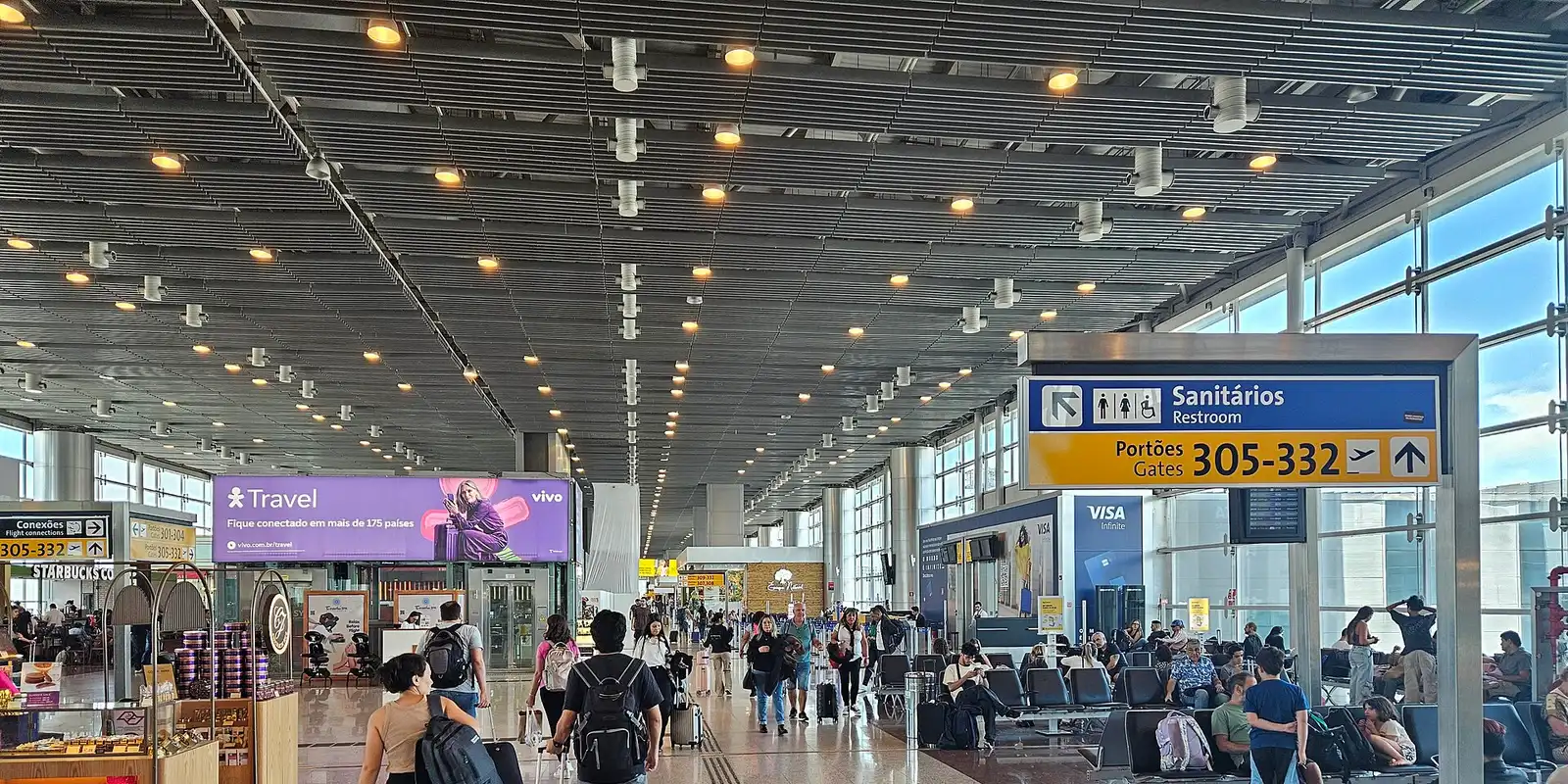
It is a budget, not a clock that starts when you land. GRU describes four hours of free access delivered as two sessions of two hours at 20 Mbps, available across all areas of the airport. Two things follow from that shape.
First, 20 Mbps is a real figure rather than a vague promise, and it is enough for a video call, a map download or a decent-sized file. That puts GRU well ahead of airports that publish no speed at all.
Second, four hours is finite. A long international connection at Guarulhos can easily exceed it, and layovers here often run long because of the inbound wave from Europe and North America. Spend the allowance deliberately: download what you need early, rather than leaving a browser streaming in the background.
You are offered paid packages at different speeds, and Boingo runs a 24-hour customer support line for connection problems. That is a legitimate option and worth knowing about, but it is a purchase decision you are making while tired in a terminal.
The alternative is to arrive with your own data. Every co:sim plan page lists the underlying network, the install deadline and whether the plan supports top-ups, so the comparison happens at home with a full battery instead of at a gate with 6%.
Brazil's telecoms regulator, Anatel, publishes public data on mobile accesses, which is the right kind of source to consult about the market rather than a comparison site with an affiliate link.
See current co:sim Brazil eSIM plansTreat every shared airport network as untrusted, even a well-documented one. HTTPS protects the contents of correctly configured sites, but a look-alike hotspot can still redirect you to a false page or capture what you type into it.
The no-registration design actually helps here. Since the genuine free tier asks for nothing, any screen requesting an email address, a document number or card details is immediately suspect. Do not install a certificate, a configuration profile or an app to get online.
Keep the connection for low-risk work such as an offline map, a boarding pass or a timetable, and keep banking, password resets and account recovery on mobile data. Afterwards, tell the phone to forget the network so it does not silently rejoin something similar later.
By train, and GRU publishes the specifics on its own train page. The Aeroporto-Guarulhos station sits on CPTM Line 13-Jade, which links the airport to Engenheiro Goulart, where you transfer to Line 12-Safira toward Tatuapé, Brás and Luz.
The operating hours are worth noting before booking a late flight: Sunday to Friday from 04:00 to midnight, and Saturdays from 04:00 to 01:00. Outside those hours the train is not an option.
The station's Acesso Aeroporto entrance is near the Terminal 1 car park, and GRU runs a free transfer shuttle between the station and the other passenger terminals. None of that happens inside airport Wi-Fi coverage in any useful sense, because you are moving and your session is a finite budget.

For most visitors, data is the actual requirement and a travel eSIM covers it. Ride apps, maps, messaging and accommodation contact all run on data, and a data-only eSIM installed before departure is working when the aircraft door opens.
A Brazilian SIM earns its place in narrower cases. If you need a local number for domestic calls, for a delivery service that insists on an SMS code, or for a stay long enough that local service sign-ups matter, a registered local line is the honest recommendation and a travel eSIM will not substitute for it.
Passenger rights and complaint routes for the flight itself sit with the civil aviation regulator, ANAC, whose passenger section is the authority rather than an airline's own summary. For an itinerary continuing across the continent, a South America regional plan covers several countries on one card.
Install at home on stable Wi-Fi rather than in the arrivals hall at Guarulhos. co:sim sends the QR code and the manual installation details by email within seconds of checkout, so the job fits into the evening before departure with a second screen showing the code.
Label the profile something obvious such as Brazil data. On arrival, select it as the mobile data line, enable data roaming on that line only, and switch off automatic cellular data switching so the phone cannot fall back to your home SIM and bill you for it.
Give registration a few minutes before changing anything. If nothing appears, toggle airplane mode or restart before touching the APN, and do not delete the profile as a first move, because many travel profiles are designed for a single installation.
Yes, and GRU Airport publishes the terms plainly: four hours of free Wi-Fi delivered as two sessions of two hours, at 20 Mbps, available across all areas of the airport, with the service provided by Boingo Wireless. You connect by selecting the .GRU WIFI network and choosing the free option on the page that loads, with no account registration required. Once the four free hours are used up, paid packages at different speeds are offered instead, and Boingo operates a 24-hour support line. Four hours is generous by airport standards but still finite, and long-haul connections at Guarulhos often outlast it. If you want a connection that does not run out mid-layover, a co:sim eSIM installed before departure carries its own data and is unaffected by the airport allowance.
No. GRU Airport's own description is explicit that the free tier takes a single click with no registration needed: you select .GRU WIFI, the Boingo page loads, and you choose the free GRU Wi-Fi Grátis option. That matters for more than convenience, because it gives you a clean security rule. Since the genuine free service asks for nothing, any page requesting an email address, a passport or identity document number, or payment card details is not the airport's free tier and should be closed. Never install a certificate, configuration profile or app in order to get online at an airport. Keep sensitive activity such as banking, password resets and account recovery on mobile data rather than on any shared network, including this one.
GRU Airport's own train page explains the route. The Aeroporto-Guarulhos station is on CPTM Line 13-Jade, which connects the airport to Engenheiro Goulart, where passengers transfer to Line 12-Safira continuing toward Tatuapé, Brás and Luz. The line runs Sunday to Friday from 04:00 until midnight, and on Saturdays from 04:00 until 01:00, so a very late or very early flight falls outside the service window entirely. The station's Acesso Aeroporto entrance sits near the Terminal 1 car park, and a free transfer shuttle connects the station with the other passenger terminals. Save the route offline before leaving the building, and have mobile data ready from something like a co:sim eSIM, because the journey happens outside any useful airport Wi-Fi coverage.
No. The travel eSIMs described here are data-only. They carry mobile internet for maps, ride-hailing, accommodation messaging, email, WhatsApp, Signal and other internet calling services, but they do not include a Brazilian number for traditional voice calls or SMS. Existing messaging accounts keep their original identity, so contacts notice no change. On a dual-SIM phone the home line can remain reachable for bank verification texts while the eSIM carries all mobile data. Before landing, switch off data roaming and automatic data switching on the home line, then confirm the data counter rises on the travel line. If you genuinely need a local number, for domestic calls or for a service that insists on a Brazilian SMS code, compare a registered local SIM instead.
Use the four free hours deliberately, then rely on a connection that covers the train, the city and the rest of the trip.
Instant delivery by email · Install before you fly
 Travel Tips
Choose unlimited eligible rides or distance-based fares by pricing your actual trips, then check service-day validity and card conditions.
 Travel Tips
A source-based guide to Quintana Roo's foreign-visitor charge: the official payment portal, children, legal exceptions and saving or recovering your receipt.
 Travel Tips
Compare Marconi Express, airport-listed buses and a taxi quote, with a clear distinction between normal rail service and a dated replacement bus.
 co:sim Team