
Back to Blog
Václav Havel Airport Prague runs one free network and names it plainly: Prague Airport WiFi Free, listed on the airport's own useful information page. What the airport does not publish is a session length, a speed figure or a login procedure, so treat the connection as best-effort rather than as a service level. For the parts of a Prague trip that cannot be best-effort, such as a night arrival and a tram to the flat, a data-only co:sim Czechia eSIM is already working when you step off the aircraft.
The airport publishes the network name and nothing else, which makes the practical sequence short.
Prague Airport WiFi Free. Match the spelling exactly against the airport's published name before joining.Because no official login steps exist, anything that asks for a passport number, a card number or a configuration profile is not the airport's network. That is a useful rule precisely because there is no official flow to compare against.
The airport does not say. Third-party guides widely repeat two figures, a throughput of around 512 kb/s and no time limit at all, and both are plausible for a free airport tier. Neither appears on prg.aero, so neither should be planned around.
What that means in practice is simple. Assume enough bandwidth for messaging, a boarding pass and a lightweight page. Do not assume enough for a film download, a large photo backup or a video call to reschedule a pickup. If a transfer depends on a file, have it saved before you reach the terminal.
This is the honest version of a claim you will see stated as fact elsewhere. An unpublished speed is not a promised speed, and repeating a number the operator never confirmed is how travel guides end up wrong for years at a time.
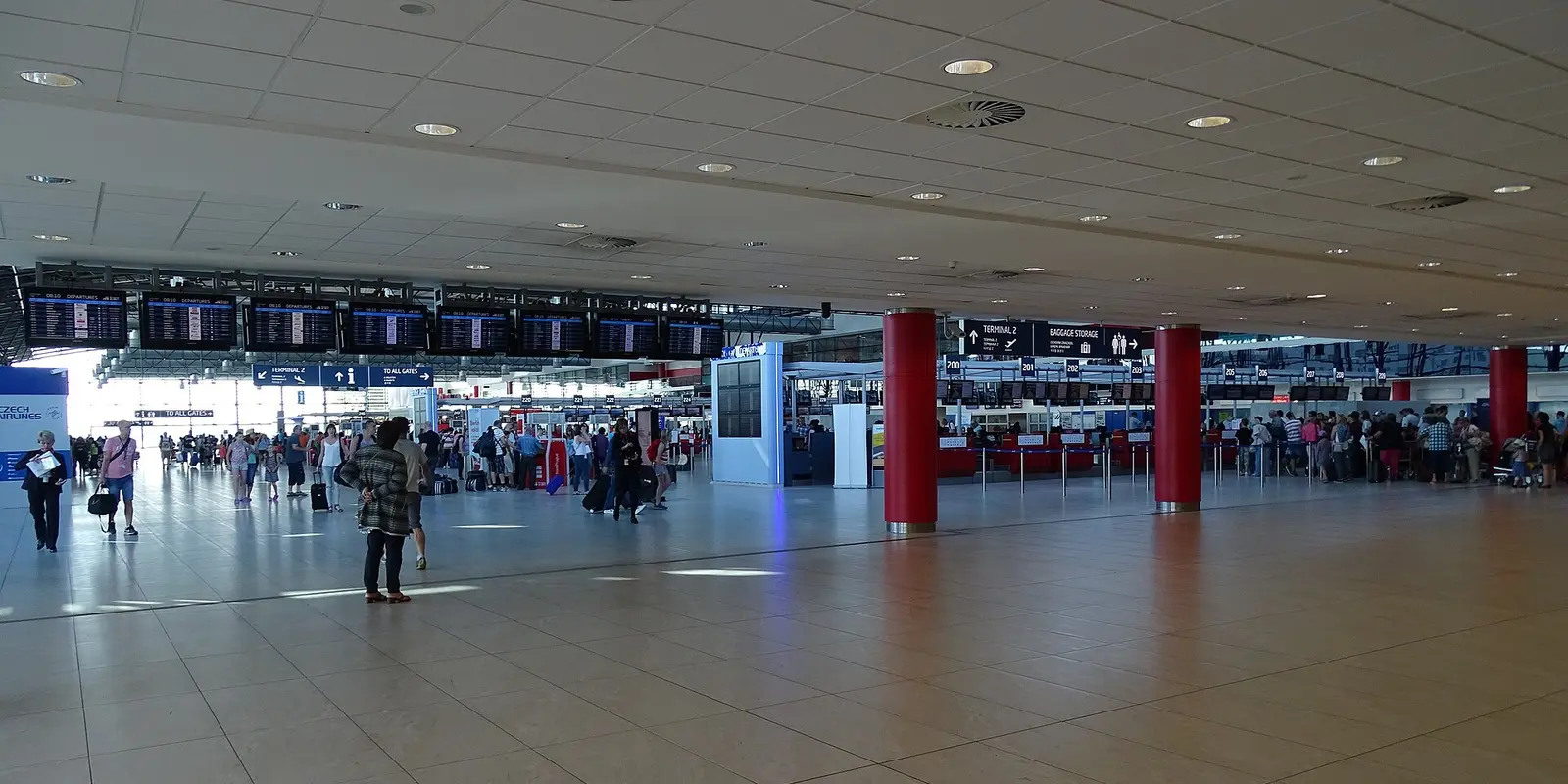
Václav Havel Airport Prague operates Terminal 1 for non-Schengen flights and Terminal 2 for Schengen flights, connected airside. The free network is an airport service and stops being available once you leave the building.
That boundary matters more in Prague than at airports with a direct rail link. The Prague Public Transit Company explains that surface access to the airport is by regular city buses and the dedicated Airport Express coach, so your first thirty minutes in Czechia are spent on a road vehicle rather than on airport property.
Download the map, the ticket details and the address before you walk out. A bus is a poor place to discover that a booking confirmation only exists in a webmail inbox.
Treat every shared airport network as untrusted, including a legitimate one. HTTPS protects the contents of correctly configured sites, but a look-alike hotspot can still push you to a false page or collect whatever you type into it. The absence of an official portal at PRG cuts both ways: there is no legitimate login page, so any login page is worth suspicion.
Keep the connection for low-risk work such as an offline map download, a boarding pass or a timetable. Keep banking, password resets and account recovery on mobile data. Reach sensitive services through a saved app or bookmark rather than a link something on the network shows you.
Afterwards, tell the phone to forget the network so it does not rejoin a similarly named access point in a café later in the week.
By bus, and that is the point worth planning for. The airport has no metro or train station of its own, so every route into the city starts with a road connection, either a regular public transit bus toward a metro terminus or the Airport Express service toward the main railway station.
Ticket machines, live departure boards and journey planners all want data, and so does the message telling your host you have landed. Every co:sim plan page lists the underlying network, the install deadline and whether the plan can be topped up, so those checks happen at home rather than in a bus shelter at 4% battery.

For subscribers on an EU or EEA contract, often yes. The European Commission's roaming rules describe the domestic-style framework and the fair-use safeguards that come with it. Check that Czechia appears in your carrier's zone and read the usable allowance rather than the headline domestic figure, because fair-use caps often differ.
Travellers from the UK, Switzerland, the Americas, Asia or elsewhere fall under their own contracts instead, where an international add-on may or may not include Czechia at a sensible rate. Compare the daily charge, the throttled speed after the cap and the tethering rules before assuming anything.
Czechia's telecoms regulator is the Czech Telecommunication Office, which is the right place to check what operators are actually obliged to deliver rather than what a comparison site claims.
See current co:sim Czechia eSIM plansThe free trial eSIM for Czechia is a separate offer for new customers. It needs an account and a card for verification, and the card is not charged.
FREEClaim a free Czechia eSIMInstall at home on stable Wi-Fi rather than in the arrivals hall. co:sim sends the QR code and the manual installation details by email within seconds of checkout, so the install fits into the evening before departure with a second screen to hand.
Give the profile an obvious label such as Czechia data. On arrival, select it as the mobile data line, enable data roaming on that line only, and switch off automatic cellular data switching so the phone cannot fall back to your home SIM without telling you.
Allow a few minutes for registration before changing settings. If nothing appears, toggle airplane mode or restart before touching the APN, and do not delete the profile as a first move, because many travel profiles are designed for a single installation. If the trip continues beyond Czechia, a Europe regional plan covers several countries on one card.
Yes, it is free. Václav Havel Airport Prague lists a free Wi-Fi network under the name Prague Airport WiFi Free on its own useful information page, and that published name is the one to match in your Wi-Fi settings before joining anything. The airport does not publish a login procedure, so in many cases pages simply start loading once you connect, with no splash screen at all. That is normal at PRG rather than a fault. Because there is no official login page, treat any screen asking for a passport number, a payment card or a configuration profile as untrustworthy. Use the connection for a map download or a boarding pass, and keep anything sensitive on mobile data such as a co:sim eSIM, which carries its own connection and does not depend on the airport network.
The airport does not publish either figure. Third-party travel guides widely quote a throughput of roughly 512 kb/s and state that there is no time limit, and both are plausible for a free airport tier, but prg.aero confirms neither, so neither belongs in your plan. The practical reading is to expect enough bandwidth for messaging, a boarding pass and a light web page, and not to expect enough for a large download, a photo backup or a video call. If something you need is large, download it before you reach the terminal. A traveller who needs a predictable connection for a late arrival or a bus transfer is better served by a prepared data plan such as a co:sim eSIM, whose plan page states the underlying Czech network before you buy, than by an unpublished best-effort service that the operator has never described.
By road. Václav Havel Airport Prague has no metro or railway station of its own, and the Prague Public Transit Company describes surface access as regular city buses plus the dedicated Airport Express coach. Regular buses connect the terminals with metro termini, from which the underground continues into the centre, while the Airport Express runs toward the main railway station. Either way, the first part of the journey happens on a road vehicle, away from airport Wi-Fi, which is exactly when a maps app, a ticket purchase and a message to your host all want data. Save the address, the route and the booking reference offline before leaving the terminal, and have mobile data ready so a missed bus does not turn into a missed check-in.
No. The travel eSIMs described here are data-only. They carry mobile internet for maps, transport apps, email, WhatsApp, Signal and other internet calling services, but they do not provide a Czech number for traditional voice calls or SMS. Existing messaging accounts keep their original identity, so contacts notice no change. On a dual-SIM phone the home line can stay reachable for bank verification texts while the eSIM carries all mobile data. Before landing, switch off data roaming and automatic data switching on the home line, then confirm the data counter rises on the travel line. If a longer stay genuinely needs domestic calls or a local number, compare a registered local SIM and check what your home carrier charges for incoming calls and voicemail abroad.
Use the airport network for what it is good at, then rely on the connection that covers the bus, the tram and the rest of the week.
Instant delivery by email · Install before you fly
 Travel Tips
Choose the Hong Kong–Macau crossing that fits your hotel, arrival terminal and return plans. Distinguish the bridge shuttle from a city coach and airport transfer.
 Travel Tips
Decide whether a Stockholm sightseeing pass fits your actual visits, pace and travel dates, with boat availability and public transport kept separate.
 Travel Tips
Choose between Flybus and public bus 55 by checking your arrival time, the actual endpoint and the final journey to your Reykjavík hotel.
 co:sim Team