Hong Kong is one of the easiest places in Asia to arrive already connected, and one of the slower places to buy a SIM after you land. co:sim's free eSIM for Hong Kong, a new-user offer, gives you 1 GB valid for 7 days from first connection, $0 at checkout, on the csl and SmarTone 5G networks. Install it at home and it goes live the moment your phone finds a Hong Kong network at the airport.
This guide covers what the free plan includes, whether 1 GB lasts a typical Hong Kong trip, how its two networks actually perform, why a local tourist SIM now means passport registration, and how to claim and install the eSIM before you fly.
The Star Ferry on Victoria Harbour, where both networks cover the water and both shores
It is a data-only eSIM (an embedded SIM profile you download instead of inserting a plastic card). These are the terms from the live plan and the claim page:
Term
Free Hong Kong eSIM
Data
1 GB total
Validity
7 days, counted from first connection in Hong Kong
Networks
csl and SmarTone, 5G
Coverage
Hong Kong only, not Macau or mainland China
Phone number
None, data only
Top-ups
Reloadable onto the same eSIM
Cost
$0; your card is verified at checkout, not charged
Eligibility
New customers, once per person
Two of those terms matter more than they look. The seven days start when the eSIM first attaches to a Hong Kong network, not when you buy or install it, so setting it up a week before departure costs you nothing. And the new-user offer is one free eSIM in total, across every destination it covers, so claiming Hong Kong means you will not also get the free Europe or Japan card.
For most visits, yes, because most visits are short. The Hong Kong Tourism Board puts the average overnight stay at 3.1 nights in 2025, comfortably inside a 7-day plan. The real limit is data, not days.
Maps, messaging, ride-hailing and looking things up are light uses of data. Video calls, streaming and automatic photo backup are heavy ones, and a fast 5G connection makes them easy to trigger without noticing. Before you land, switch off photo backup and app updates over cellular, and keep video for the hotel Wi-Fi.
Hong Kong also does a lot of the heavy lifting for you. The tourism board's Get Online guide lists free Wi-Fi.HK hotspots at major attractions, malls, museums and ferry terminals, and MTR Free Wi-Fi on the concourse and platforms of every MTR station, at 15 minutes per session and up to 10 sessions per device per day. Use those for anything big, and let the eSIM carry you between them.
If you do run out, the plan is reloadable: top up from your account dashboard and the same eSIM keeps working, with no reinstall and no new QR code.
#Which networks does it use, and how fast are they?
The free plan roams onto csl and SmarTone, two of Hong Kong's four mobile network operators, both on 5G. Every co:sim plan page lists the underlying networks before you buy, which is the honest way to compare eSIMs: the network decides your experience far more than the label on the plan does.
To be straight about it, China Mobile Hong Kong was the fastest operator in the same report, at 88.7 Mbps, and it is not on this plan. csl came second on everyday download speed. For maps and messages the more telling line is Time on Network: on either operator, a phone had a usable signal more than 99% of the time.
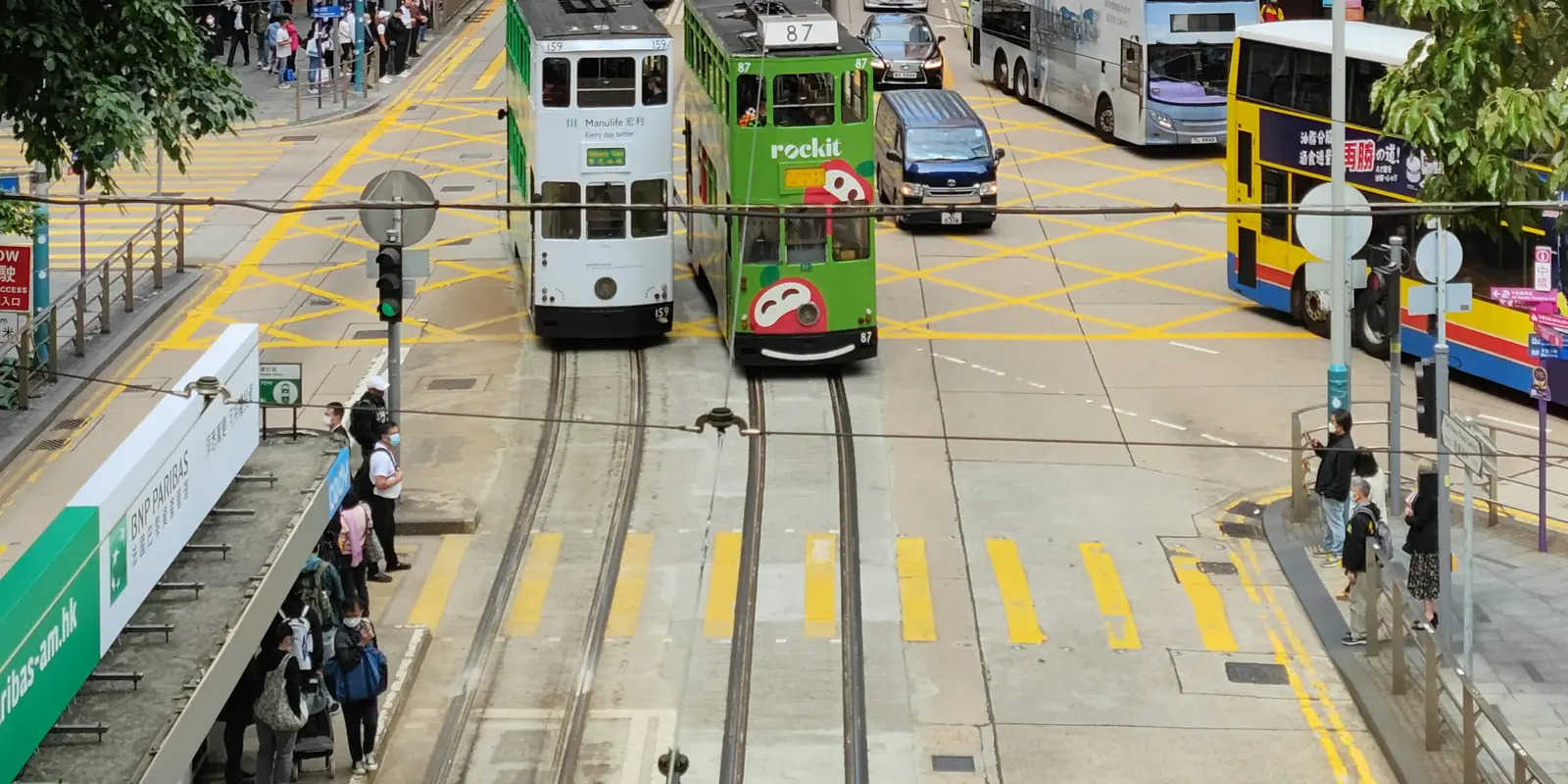
Trams on Des Voeux Road Central, the kind of street you navigate by phone
For a longer or data-heavy trip, a local tourist SIM is genuinely good value, and you should consider one. The tourism board lists csl's 5G Discover Hong Kong Tourist SIM Card at HK$88 for a 7-day pass with 50GB, sold at 1010 and csl shops and more than 1,000 7-Eleven and Circle K stores, with an eSIM version sold online.
Feature
co:sim free eSIM
csl tourist SIM, 7-day pass
Price
$0
HK$88
Data
1 GB
50GB (20GB of it shareable with Macau)
Phone number
No
Yes, with local calls
Registration
None in Hong Kong
Real-name registration before activation
Ready on landing
Yes, installed at home
Once registration is complete
The catch is that registration row. Since 24 February 2023, every SIM card issued in Hong Kong must complete real-name registration before it works, and visitors register with a passport, according to the regulator's SIM registration FAQ. Hong Kong ID holders can verify through the iAM Smart app; for everyone else the operator checks the details manually, and OFCA says the processing time varies by provider.
csl's tourist eSIM follows the same rule. Its product listing says service starts only after you complete registration through an SMS link, and that phones unable to receive SMS are not supported.
A co:sim eSIM is a data-only roaming profile issued outside Hong Kong's local registration scheme, so there is no Hong Kong registration step; co:sim runs its own checks at checkout. The difference shows up on arrival. The Airport Express reaches the city in as little as 24 minutes, which is time better spent checking the route to your hotel, or adding a digital Octopus card through the Octopus App for Tourists, which you top up online with a non-Hong Kong Visa, Mastercard or UnionPay card.
At checkout, enter your email and a valid payment card for verification. Your card receives a $1.00 3D Secure authorization hold, released once the eSIM is delivered; nothing is charged.
Your QR code arrives by email within seconds.
Scan it on home Wi-Fi. On iPhone, follow Apple's eSIM setup steps under Settings → Cellular → Add eSIM. On most Android phones, use Settings → Network & internet → SIMs → Add eSIM.
When you land, switch the new line on and enable data roaming for that line only.
Do not claim it months ahead of the trip. The eSIM has to be installed and activated, meaning its first connection in Hong Kong, before the deadline shown on your order, and one that is never activated by then is cancelled, even if it was installed.
Continuing to Shenzhen or Macau? This card stops at the boundary. The China and Hong Kong plan covers both sides on one profile, and our Macau eSIM guide covers the ferry side.
#Is the free Hong Kong eSIM the same offer as co:sim's free Europe eSIM?
No. co:sim's new-user free eSIM is a single promotion delivered through several separate products, and they are different cards. One is a regional plan covering 33 European countries on a single profile. The others, Hong Kong among them, are single-destination cards: the Hong Kong version works throughout Hong Kong and nowhere else, with no roaming into Macau or mainland China. The promotion can be claimed once per new customer, so this is a choice between destinations rather than a set to collect. Take it for wherever you land first, or wherever you will spend the most days without other connectivity arranged. If Hong Kong is a short stopover on the way to somewhere else on the list, the free card may do more for you at the longer stop. The current list of destinations is on the free eSIM hub.
#Does the free Hong Kong eSIM work in Macau or mainland China?
No. Hong Kong, Macau and mainland China run separate mobile networks under separate regulators, and the free Hong Kong eSIM covers Hong Kong only. It stops carrying data once you cross into Shenzhen, whether on foot at the Lo Wu boundary or by high-speed rail, and it will not work in Macau, whether you arrive by ferry or across the Hong Kong-Zhuhai-Macao Bridge. The same boundary applies to Hong Kong's free public networks, since Wi-Fi.HK and MTR Free Wi-Fi are local services. Greater Bay Area itineraries are where this catches people out most often. If your trip crosses into the mainland, a plan that explicitly lists both sides, such as the China and Hong Kong bundle linked above, avoids switching data mid-journey. For Macau, buy a Macau plan for those days and keep the free Hong Kong card for the Hong Kong part of the trip.
#Do I need to register my passport to use the free eSIM?
Not in Hong Kong. The city's real-name rule, fully in force since 24 February 2023, covers SIM cards issued by Hong Kong's own telecommunications providers, which must be registered with an identity document before activation; visitors use a passport. The co:sim eSIM is a data-only roaming profile from an international provider, issued outside that local scheme, so there is nothing to register on arrival. co:sim does run its own checks when you claim: you sign in, then enter your email and a valid payment card, which is verified but not charged. The trade-off is that you get no Hong Kong phone number. If you need a local number to receive calls or SMS codes from Hong Kong services, a registered local SIM is the right tool, and the passport step comes with it. For data alone, the eSIM skips that queue entirely.
#What happens when the 1 GB or the 7 days run out?
Whichever limit you reach first ends the plan's data. The seven days start at first connection in Hong Kong, not at purchase, so installing the profile at home before the trip does not quietly consume the validity; the clock begins when the eSIM first attaches to csl or SmarTone. Once the allowance or the days are used up, the plan is reloadable: top up from your account dashboard and the same eSIM carries on working, without a reinstall or a new QR code. You can also switch to a paid Hong Kong plan with a larger allowance for a longer stay. Nothing on the phone breaks when the free plan ends. The line simply stops carrying data until you top it up, while your home SIM keeps its number, calls and texts exactly as before.
It needs to support eSIM and must not be locked to a carrier. Most recent iPhone, Pixel and Samsung Galaxy models support eSIM, but one detail matters for this destination in particular: where the phone was bought. Apple says that in China mainland, only iPhone 18 Pro, iPhone 18 Pro Max, iPhone 17e and iPhone Air support eSIM, and that certain models sold in Hong Kong and Macao use two physical nano-SIM cards instead. A traveller carrying an older mainland-bought iPhone may therefore have no eSIM option at all, even though the same model bought elsewhere does. On iPhone, a quick check is Settings → General → About: if an EID number is listed, the phone can hold an eSIM. Check this before you claim, since the free offer cannot be claimed a second time for another device.
Landing in Hong Kong with a working connection costs nothing if you plan one evening ahead. Claim the free eSIM, install it tonight on your home Wi-Fi, and switch it on when the aircraft doors open.

 co:sim Team